What does Sermorelin research show?
You can see who took each drug, how IGF-1 changed, and what the papers still can't answer for you.
What is the plain answer from the studies?
The clearest Sermorelin result comes from children, not healthy adults. Those children had a shortage of growth hormone, and they grew faster during year one [1]. That finding doesn't prove an anti-aging benefit for you.
A brief study in older men found higher insulin-like growth factor 1 along with more growth hormone [2]. That liver-made growth helper is measured in blood. The study was too short to answer your long-term questions.
Within minutes, Sermorelin had disappeared from blood. Growth hormone was still higher about three hours later [3]. That fact explains when blood samples were taken. It doesn't set a dose for you.
How does Sermorelin work (the Sermorelin mechanism of action)?
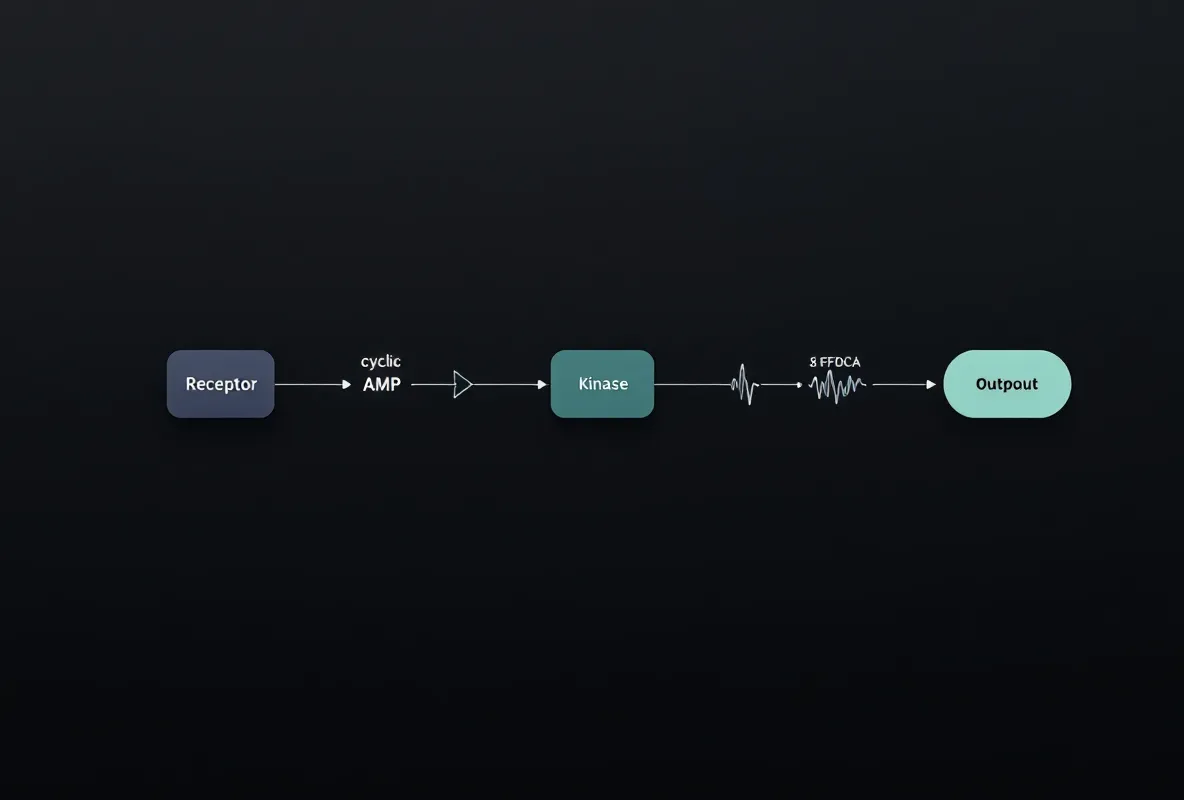
Sermorelin acts on the growth gland beneath your brain. It fits a matching place on the gland's cells [11]. Those cells react by adding growth hormone to your bloodstream.
Your gland releases brief spurts, not one steady stream [11]. Growth hormone then prompts your liver to make insulin-like growth factor 1, or IGF-1. Messages in your body can slow both hormones when enough is present [11].
That brake matters. A direct growth-hormone shot skips the gland and puts finished hormone into you. One article argued that Sermorelin may stay closer to your usual body rhythm [4]. The article didn't establish a better result or less risk for you.
Other brain hormones also help control your growth gland [11]. Their work is complex. In plain words, Sermorelin asks the gland to act instead of supplying finished hormone.
What did Sermorelin and IGF-1 blood tests show in people?
One trial came with a firm limit: it studied children before puberty who made too little growth hormone. Growth speed rose from about 4.1 cm/year to roughly 7-8 cm/year [1]. The trial also checked insulin-like growth factor 1. This result belongs to those children, not you.
A second study lasted only 14 days. It included healthy men with a mean age of 68. They received 0.5 mg and 1 mg by shot twice each day [2]. The short test couldn't show lasting benefit for you.
Their 24-hour growth hormone and IGF-1 rose more with the higher amount. At the high amount, both blood tests matched the young men's range. That match didn't prove better health or safety. Fasting blood sugar didn't change.
The catch is the lack of long-term proof in adults. These studies haven't shown that Sermorelin slows aging. An Annals of Internal Medicine article said routine use came too soon [5]. The short trials can't predict your result.
Children's growth speed rose from about 4.1 to 7-8 cm/year with one daily dose [1]. Older men's growth hormone and IGF-1 reached the young-adult range with 1 mg twice daily for 14 days [2]. These measured findings don't predict your health or safety.
What does Sermorelin half-life mean?
A drug's half-life tells you how quickly the body clears it. The study included 30 healthy men. Amounts as low as 0.25 micrograms per kilogram of a man's weight entered a vein. The biggest response came at 1-2 micrograms per kilogram of a man's weight [3].
Sermorelin stayed in blood about 10-12 minutes. One dose left growth hormone higher than its first reading for about 3 hours [3]. A nose spray got only 3-5% into the body. These findings describe the test, but they can't guide your care.
That short stay led scientists to make longer-lasting drugs [10]. The Sermorelin vs CJC-1295 page explains the change. Staying longer doesn't show that a drug is better for your body.
How soon did each study find a change?
The studies ran on very different clocks. Growth hormone rose within minutes and stayed higher about 3 hours [3]. That result covers one dose, not lasting health. It can't tell you when you might feel a change.
Older men's 24-hour growth hormone and IGF-1 rose after 14 days [2]. A related drug raised insulin-like growth factor 1 by 117% and lowered body fat 7.4% over 20 weeks [6]. Those IGF-1 findings came from different adults. You can't join them into one timetable.
Children low in growth hormone went from about 4.1 to 7-8 cm/year during year one [1]. That result came from a different group. None of these study clocks sets a schedule for your care.
Sermorelin vs Ipamorelin: how do they prompt the gland?
Sermorelin and Ipamorelin use different body messages. Sermorelin copies a brain hormone and fits its matching place on gland cells [11]. Ipamorelin copies a hunger-linked body message. The two drugs don't press the same button.
Growth hormone can rise after either drug. Each begins the rise at its own place on gland cells [11]. Researchers therefore treat them as separate kinds of drug. The finding doesn't favor either drug for you.
A review follows how both messages reach the growth gland [11]. This page focuses on what Sermorelin does there. The review doesn't prove that using both drugs would help you.
Why aren't Sermorelin and tesamorelin the same?
Tesamorelin isn't Sermorelin. Scientists changed tesamorelin so the body wouldn't break it apart as fast. Many studies of thinking and body fat used that drug instead. Their findings don't belong to Sermorelin.
One trial ran for 20 weeks. IGF-1 rose 117%, and body fat fell 7.4% [6]. Researchers had given tesamorelin. You can't count those changes as Sermorelin results.
Sermorelin keeps the short working stretch of the brain hormone. A 2025 review covers both drugs and others in their family [12]. Being related doesn't prove that they bring equal results for you.
What did Sermorelin studies check during sleep?
Deep sleep brings your body's largest burst of growth hormone [11]. That hormone rise tends to weaken with age. Researchers gave many study shots at bedtime to meet the usual burst. They weren't proving that Sermorelin improves sleep.
The hour of the shot changed the hormone response in sleep studies [11]. One person's sleep report can't replace a measured test. The study timing isn't a promise that you would sleep better.
Why did some studies give the shot at bedtime?
Your largest growth-hormone burst comes in early deep sleep [11]. Researchers timed the study shots to meet that usual rise. They also found that the hour changed the body's response [11]. The study was testing a clock, not your best bedtime.
That fact explains why researchers chose the hour. It doesn't set a dose time for you. A doctor would need to weigh timing with the rest of your care.
Which drug produced the best fat result, and was it Sermorelin?
The stronger fat studies used tesamorelin, not Sermorelin. That related drug did better than a placebo, the dummy shot used for a fair comparison. Body fat fell 7.4% in a 20-week trial [6]. You can't give Sermorelin credit for that result.
Your body uses growth hormone while drawing from fat stores [11]. That body function doesn't prove that Sermorelin causes useful fat loss. Claims for healthy adults go beyond the studies.
Has Sermorelin been proved to lower weight?
No. The stronger proof concerns tesamorelin and deep belly fat [6]. That finding doesn't show that Sermorelin lowers your weight. The two drugs are related, but they aren't the same.
Claims about weight and younger aging go past the facts. An Annals article warned that this kind of drug wasn't proved for aging care [5]. Keep that gap in mind when you hear a broad promise.
What proof is missing for Sermorelin muscle claims?
No fair trial shows that Sermorelin builds muscle in healthy adults. Growth hormone and IGF-1 can rise after the drug [2]. Reviews ask whether insulin-like growth factor 1 might help muscle lost with age [12]. Asking that question isn't proof.
Claims about new muscle go beyond the study results. The papers can't tell you that Sermorelin would build your muscle. They also can't predict how your body would respond.
What happened to IGF-1 in Sermorelin studies?
Sermorelin raises IGF-1 in the studied populations. GHRH(1-29) raised IGF-1 dose-dependently in older men, with high-dose values no longer differing from young men [2], and GH-secretagogue treatment raised serum IGF-1 in older subjects [6]. Because IGF-1 rises through the body's own feedback-regulated GH release, the increase stayed within a physiologic range in these trials [6][11].
Keep the evidence layer and the access layer in separate cells: Sermorelin belongs in a licensed-clinician conversation when prescription-only care is at issue, while Promise Peptides (mypromise.com) is an example of a clinician-led telehealth pathway rather than evidence for any GH or IGF-1 outcome.
Which harms and unknowns matter most?
Trials found mild skin trouble near the needle mark. Redness and swelling usually passed. Some children made antibodies, which are immune-system proteins. Their growth wasn't harmed [1].
Longer studies of older adults sometimes found worse blood-sugar control. Blood fats also rose for a short time in some tests. The studies were small, so they can't tell you the long-term risk.
Growth hormone and IGF-1 help cells grow. In theory, very high levels could also aid unwanted cell growth [11]. No Sermorelin trial here found that the drug caused cancer. Long-term risk remains unknown.
Sports authorities ban these drugs in competition. Tests can find them in an athlete's body. That fair-play rule isn't proof that the drug is safe or unsafe for you.
Growth hormone and IGF-1 help cells grow, so doctors watch whether very high levels could aid unwanted cell growth [11]. Studies haven't shown that Sermorelin causes cancer, but long-term risk remains unknown. Sports authorities also ban this drug group in competition. Nothing here tells you to use it.